Thursday, November 15, 2007

The "dam stone"


Someone else has already said it – sometimes you have to travel a long way from home to learn something important about your home! In our case it involved the "dam stone!"

At the "Little White House" there was a walkway over to where the museum had originally been that was lined with a procession of the flags of the fifty states and a stone from each state. Each state had been asked to send a special stone to represent their state – usually a variety of stone found in that state carved or engraved with an outline of the state or some such. However the stone from the state of Washington was apparently just a stone – neither a distinctive type of stone from the state nor any carved or engraved shape.

The story is that the widow of James Delmage Ross, who had held two positions in the Roosevelt Administration – member of the first Securities and Exchange Commission, created to prevent any future market crashes, and director of the Bonneville Power Authority to oversee the construction and operation of that dam – had heard of the request for a stone and had asked that a stone be removed from the Ross Dam on the Skagit River northeast of Seattle and sent for Washington's stone.

J.D., as he was known, had been the sparkplug and the designer of the whole Skagit River public power operation, a system of three dams supplying nearly half of the electricity to the city of Seattle. The design and construction had occurred during the 1920's in spite of opposition from some in the area who decried this type of "Socialism" involved in the intrusion of a city into the public power arena. So fierce was the fighting that a Mayor of Seattle who opposed the project was thrown out by a specially called "recall" election!

The biographical sketch of Ross that I found called him "The Father of Seattle City Light." The most amazing part is that Ross, an immigrant (from Canada) was completely self-taught in all of electricity generation, dam design and dam construction, but was obviously quite skilled at "getting the job done."

Friday, November 9, 2007

A story in four pictures


Those who have followed closely do not need any text for this episode – they can write the text just by looking at these four pictures . . . the only facts not obvious from the pictures are that picture #1 was taken in Lanett, AL and #2 in Montgomery, AL.

P.S. If you haven't been following quite closely enough, the first picture shows the Alabama Welcome Center as you enter from Georgia on I-85. While there, we got a recommendation for lunch (in Montgomery) by pinning the greeter down with the question "Where would you be going for lunch if you were in Montgomery today?" after the generic "What do you recommend?" produced a very wishy-washy list . . . The third picture shows Clara's plate of Bar-B-Q Pork with collard greens, candied yams and corn bread muffins -- the most Southern choices on the menu -- while my plate has the same first two and a side salad. Put this together with apple cobbler for dessert, lemonade and iced tea, all for $6.75, and you've got a true Southern treat. The place was touted as the most Southern available -- when in New England, eat lobster . . . when in the South, eat Bar-B-Q.

Lessons at "The Little White House"


As we have learned from previous stops at other sites, one learns more from talking with Park Rangers and other staffers than from all of the exhibits in the museum.

Consider the situation that FDR confronted when he was elected in 1932 – a two-pronged challenge consisting of
a) thirteen million men without jobs in the U.S.
b) a charismatic but dangerous leader emerging in Germany

First the unemployed – remember that the U.S. had only some 130 million total population and this was ten percent. But take out the women and it's now twenty percent, still further take out the children and the elderly and you're looking at about thirty-five percent unemployment. Add to that the poverty that existed even when some of the men were employed and you've got a monumental problem.

Second, FDR had read Mein Kampf when it came out and recognized what it represented – he made the statement at that time "We'll have to have a war with this fellow within ten years – if he is to be stopped at all!" Put this in the context of one above, meaning a country in tatters facing an inevitable war of sizable proportions, and you've got a huge problem.

If you view the federal government as a powerful force that should be put into positive action to improve the common good of all the people of the country, i.e., a Socialist view as opposed to a view such as that of Grover Norquist ("shrink the federal government until it is so small it can be drowned in the bathtub"), then you can go into action creating programs to put people to work at projects that enhance the country's infra-structure and recreational facilities, etc.

One interesting new insight, not in any of the exhibits but mentioned by two of the staff, came in the person of one Louie Howe, described as the only person who was a close friend of both FDR and Eleanor. He is given the credit for the idea of the fireside chats as a way to communicate with the American people. One biographical sketch of Howe describes him as "the man who created FDR as President." Others, and the staffers, attributed many of the New Deal programs to him, as well as the text of many of FDR's speeches.

Another new insight, in many of the exhibits, was that FDR's contacts with the people of Warm Springs gave him ideas for some of the programs. In fact it's in his own words that the Rural Electrification Administration arose because of the fact that his electric bills at his home in Warm Springs were five times as much as at his home in Hyde Park.

The complexity of FDR's work is best seen in his design and implementation of the REA. He was not sure it would work, but wanted to try it, so did not want it to be cast in stone (as a law.) He had plenty of opposition in Congress to anything that smelled of liberalism, to say nothing of the extremely pro-active programs he was proposing, and did not want that battle. Then there was the Supreme Court which had been giving him grief on the same basis as some of those in Congress. The solution – establish the program by Executive Order – easily withdrawn, not subject to Congressional approval, not subject to review by the Court . . .

Ultimately the success of his program for rehabilitating the country and improving the lot of the poor and powerless can be found in the industrial might of the U.S. in the early 1940's as it produced war materiel for its Allies and built its own military in anticipation of the war soon to follow.

The following quote from "delanoye.org" describes the events of the last day of FDR's life. I've included both of "The Unfinished Portrait" and the complete rendering of the similar portrait done by the artist from her memory of that day.

On Monday, April 9, Lucy Rutherford, accompanied by her painter friend, Elizabeth Shoumatoff arrived to spend the final week of the vacation with the President. Lucy and Roosevelt met when he was assistant secretary of the navy, and FDR became quite smitten with her. Lucy brought Shoumatoff with her to paint a portrait of Roosevelt during their stay.

On April 11, Roosevelt worked on a draft of his upcoming Jefferson Day speech, well-crafted words and sentiments that would mirror his faith in the American spirit: "The only limit to our realization of tomorrow, will be our doubts of today. Let us move forward with strong and active faith."


At noon the following day, Elizabeth Shoumatoff began work on FDR's portrait. The President sat in the living room dressed in a double-breasted gray suit and crimson tie. Surrounded by Lucy and several others, Roosevelt sifted through a stack of papers as Shoumatoff sketched.

At around 1:00 p.m. Eastern Time, the butler brought FDR and his party their lunch. At that moment, Roosevelt seemed agitated and flinched in his chair. An assistant asked the President if he needed help. FDR's head went forward. He gripped his head with his left hand and said, "I have a terrific headache." They would be his final words. The President collapsed and lost consciousness.

End quote . . .

Clara noted on the reading with this "unfinished" portrait the comment "after the death of FDR the artist picked up her paints and supplies, and she and Lucy left" -- the only mention of Lucy either of us saw (or heard) in the entire exhibit.

Thursday, November 8, 2007

More than food . . .


Sometimes when you stop by a restaurant for some food, you get more than food . . .

When you look at these first two pictures, you'll see what I mean. And the food was pretty good, too.

We had done our usual (on our food tourism routine,) stopping at the Georgia Welcome Center as we crossed the border, and asking for a recommendation for lunch. The choice was the "211 Main," a Mennonite owned and operated restaurant in nearby Lavonia, GA.

Lavonia turned out to be a quaint and tiny "wide spot in the road," the "211" was easy to find because "Main" was only a few blocks long, and "Main" was
the only street off the highway. It was busy and noisy, attesting to its popularity with the locals. The waitresses all had their hair in tight buns covered with little black caps, and all wore long country dresses, as you can see.

They also had a very attractive dessert case from which Clara got a chocolate pecan pie for the evening.

For me, I went for a walk . . . while she went to Ola's Quilt Shop . . . she found a piece of fabric while I found an interesting mural set behind the gazebo on the town square for an interesting optical illusion.

Later we drove through Atlanta on our way to FDR State Park – more on that tomorrow.

Tuesday, November 6, 2007

Catching Up After Fifty Years


At the end of our trip south on the Blue Ridge lay a real treasure – some old friends we had not seen or kept in touch with for fifty years. Bob and I had been room-mates during our third year as undergraduates, i.e., 1957! It was amazing how easily we picked it up again, as if it had only been the day before yesterday.

It was virtually non-stop conversation from breakfast to bedtime, on everything under the sun – from "Evolution vs Intelligent Design" to "Are we smarter or dumber with GPS and Google" and "Baptists vs Presbyterians vs Unitarians."

Our first evening we had baby-back ribs which Bob prepared according to the recipe of his brother-in-law, with whom he can talk ribs but neither religion nor politics. At least the brother-in-law is right about the ribs . . .

The first picture shows us at breakfast – even without the plate of sausage and eggs you can tell where I'm setting. The caption on that second picture is "Catching Up After Fifty Years!"

On our second evening we went to "Michaels on 4th" where the chef was extraordinary – he made my tuna rare and Bob's medium well -- simultaneously! And, most amazing for someone far from New England or the ocean, he knew what "dry scallops" were and that was what he was serving – Clara loved them in Cajun style.

The topper of the evening, after we got out the old college yearbooks – "Do you remember …. ?" – was the tasting of the Single Malt Scotches [Eat your heart out, Diane!!] – first "The Balveni DoubleWood" a 12 year old aged first in oak, then in sherry wood, followed by a "Dalwhinnie" a 15 year old so mellow and smooth it melted . . .

The Trip South


In contrast to our earlier travels, where we went on the by-ways to see the local attractions, we now began to simply cover some miles. So our first jaunt from Galion to Marietta, Ohio was a matter of Interstate Highways. Nonetheless, Fred Garmin, our resident GPS guru, managed to make lunch interesting by misplacing our destination by a full city block, telling us we had arrived at the LaFayette Hotel when in fact we were just next to The Old Levee House. [A short footnote: Fred went totally bonkers as we approached my cousin's home last Saturday, because the main highway leading there was only two years old and not in his memory bank – he just sat there spinning round and round and "Re-calculating . . . "]

This first picture shows the Levee House – lunch was, in fact, quite good, and the view of the Ohio River out the front window was spectacular.

We wound up that first night at a rather disheveled campground which was, nonetheless, brightened considerably by this flag . . .

Then it was on to the Blue Ridge Parkway where the typical windshield view looked exactly like this one. The total 450 miles or so of Blue Ridge Pkwy is something to behold, although we only covered about 100 miles of it. It's a real pleasure to meander along through fantastic scenery.

Our campground that night had a spectacular setting, but was largely populated by empty trailers waiting for next summer and the return of their owners. Down the road from there we ran across a commemoration of (what we thought was "Tom Dooley") one Tom Dula, while in the opposite direction from that very site was perhaps the best color we've seen in our whole trip.

The Ancestral Home


The most striking thing that I learned on this trip concerned my grandparents' commitment to the education of their children. In the home shown in this first picture, located in the community known as Windfall, Ohio, my grandparents lived more than 110 years ago and witnessed the birth of six children, with the premature death of one. I've never been told why my grandparents were so committed to the education of their children, and I must admit that I was quite startled to learn that they sold the farm on which this home is located as soon as the eldest child was ready to enter high school in the (relatively) nearby town of Galion, Ohio. Without any form of transportation for the trek from home to school, and with five kids to go through it, there was apparently no alternative. [They bought a home in Galion, not far from the school, also not far from the house where I was born.] Actually, there was a sixth child since for some reason that no one knows today, my grandparents also raised Bill, son of my grandfather's brother. My grandfather, a farmer before, became custodian at the high school and stayed with that until retirement.

Beyond high school, at least two of the boys (my father and his older brother Arla) and their cousin Bill went on to college at Tri-State College in Angola, Indiana where Bill later became an engineering professor. One of my cousins (Jack, son of Arla) also went to college there.
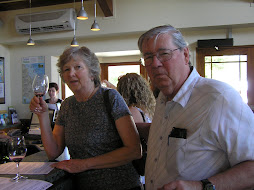
Four of the children later married and each, coincidentally, had two children. Of the eight of us of my generation, two have already died, and two were not able to be present, but the remaining four of us had a great time together at various times over three days. In the picture the cousins alternate with in-laws, not by design, but purely by happen-stance.

One interesting sidelight was a trip to nearby Bucyrus to see some murals, painted by Eric Grohe of Marysville, WA – how about that? And further, one of the murals was a tribute to American veterans and included representations of veterans from the local area, including my eldest cousin.